
Persjani: Maltese louvred shutters, timber vs aluminium
Persjani are the louvred shutters that sit outside the glass on Maltese façades. This explains the material choice, the maintenance that goes with each, and the planning rule that decides whether yours can be replaced at all.
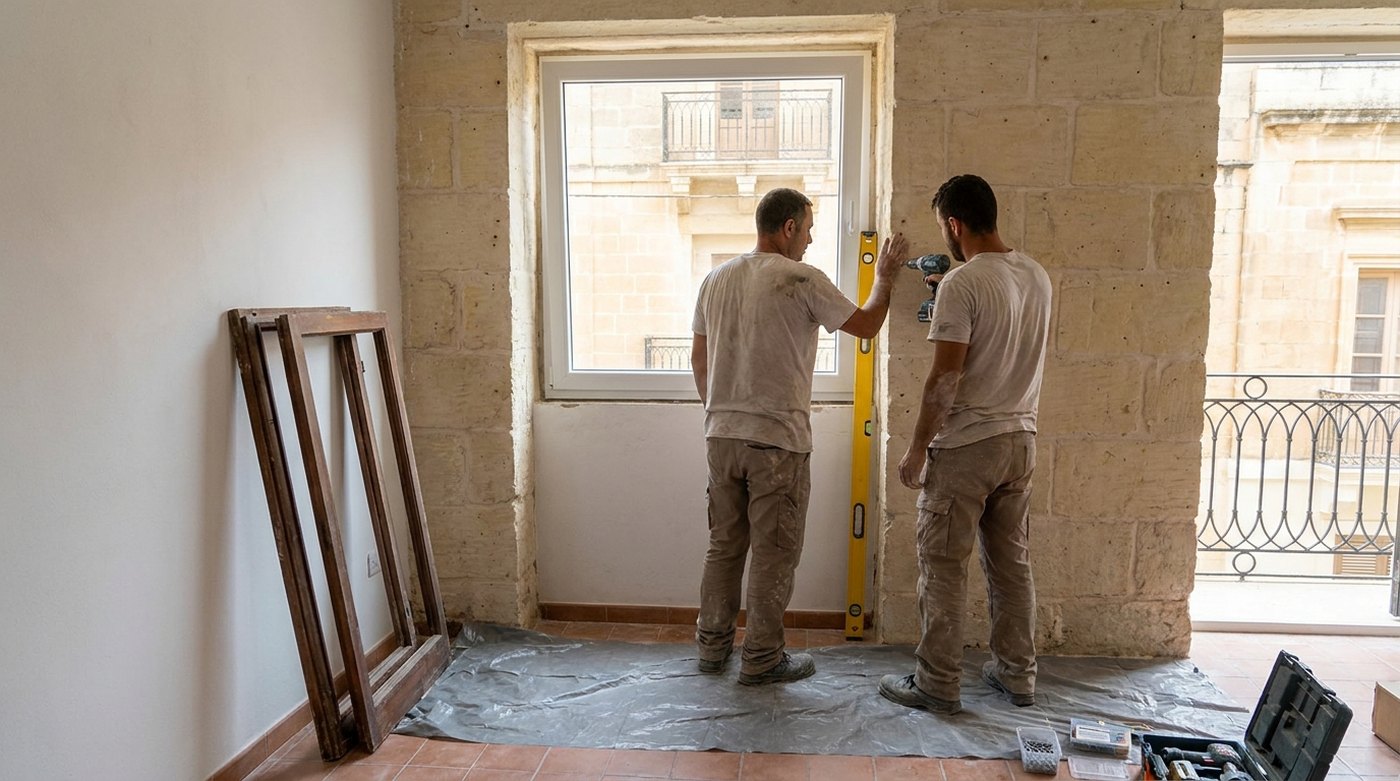
Persjani are the louvred shutters that hang on the outside of a Maltese window, in front of the glass rather than behind it. The slats are angled so that you can leave them closed against the sun and still get air and some daylight through. They are one of the few building features that are genuinely Maltese rather than imported, and on most older streets they are the thing that makes the façade read as a façade.
They are also the aperture element most often got wrong in a renovation, because the decision looks cosmetic and is not.
Why they sit outside the glass
The important word is outside. A shutter in front of the glass stops sunlight before it reaches the pane. An internal blind or curtain stops it after the glass has already absorbed it. That is the whole argument for persjani in a Maltese summer, and it is why they survived centuries of use here while internal shutters never caught on.
What persjani do not do is seal. They are not glazing. A closed persjana over a single-glazed window does nothing for noise, nothing for rain, and nothing for the winter. If your problem is traffic noise or condensation, the shutter is not the fix — the glazing is. If your problem is a west-facing bedroom in August, the shutter is doing work that no glass can do on its own.
We make no claim about how much energy or money persjani save. Nobody publishes a Malta-specific number for that, and we are not going to invent one.
Timber, aluminium, PVC
| Timber | Aluminium | PVC | |
|---|---|---|---|
| Look on an older façade | Correct | Can be close, can be obviously not | Usually reads as plastic |
| Maintenance | Repainting on a cycle; salt air and south-west exposure shorten it | Powder coat; check hinges and fixings | Little, but colour and slats can go brittle in full sun |
| Repairable | Yes — slats, stiles, ironmongery can be replaced piecemeal | Partly; bent slats usually mean a new leaf | Rarely worth repairing |
| Allowed on a scheduled façade with restorable originals | Restoration required, see below | No | No |
| Weight on old ironmongery | Heaviest | Light | Light |
Timber is the only material the Planning Authority's 2026 Irrestawra Darek scheme funded for façade fixtures on heritage buildings, and the safest choice on a protected elevation. It is also the one that asks something of you every few years. A pair of persjani on a sheltered internal yard can go a long time between coats. The same pair on a seafront elevation in Sliema or Marsalforn will not.
Aluminium is the pragmatic choice on a modern block, a shell-form apartment or a back elevation nobody sees. Louvred aluminium shutters are durable in salt air and need almost nothing from you. On a nineteenth-century townhouse front they are a different proposition entirely, and the planning position below is why.
PVC louvred shutters exist and are the cheapest route. They are also the one most likely to look wrong on anything with character, and the hardest to make good when a slat goes.
What the Development Notification Order actually says
Schedule I, Class 1(ii) of the Development Notification Order (S.L. 552.08) makes the replacement of apertures and security elements on windows, doors, balconies — including timber balconies — and gates permitted development. That includes scheduled buildings and buildings of conservation value. No notification is required for Class 1(ii).
There is a condition attached, and it carries the whole weight: the works must not materially alter the character and/or context of the building and its surroundings.
Then there is the clause that catches most heritage jobs. In a scheduled building or a building of conservation value, original wooden apertures, balconies and wrought iron that form part of the historic character of the building and that are restorable shall be retained and restored and shall not be replaced. Not "should". Not "preferably".
So the sequence on a protected façade is: are the originals restorable? If yes, you restore them. The question of timber versus aluminium does not arise. If they are genuinely beyond restoration, you are back to Class 1(ii) and the "materially alter" test.
The Order does not define materially alter, and Article 2(4)(d) provides that where opinions differ, the Authority's opinion prevails. In plain terms: nobody can promise you in advance that a given replacement passes. Anyone who does is guessing with your money.
Restoration is usually the smaller job
Old Maltese persjani were built to be taken apart. Individual slats slot in, stiles are jointed, hinges are pinned. A pair that looks dead under forty years of paint is often three sound components and one rotten one.
Our published rate for stripping, repairing and repainting timber persjani is EUR 150-400 a pair, depending on what the stripping reveals. New persjani are quoted after the measure-up — there is no published Maltese price for them, because the opening size, the louvre type, the timber species and the ironmongery all move it too far for a figure to mean anything.
Fly screens, which people often want fitted at the same time, run EUR 40-120.
The Irrestawra Darek position
The Planning Authority's Irrestawra Darek u l-Villaġġ scheme covered heritage façades in Urban Conservation Areas and scheduled buildings, at 100% of eligible costs, capped at EUR 15,000 in a UCA, EUR 100,000 for Grade 1 and EUR 50,000 for Grade 2. It funded the replacement of original façade timber fixtures in solid natural timber only. Aluminium and PVC were not funded. Replacing existing aluminium with a traditional material was eligible.
The 2026 calls are closed. The last expressions of interest were taken between 17 and 24 June 2026. We do not know whether a 2027 call will open or on what terms, and the Authority does not publish that in advance. It was never an energy scheme, so it has nothing to do with glazing performance or U-values.
Apartments, shell form and Gozo
If you are in a block, the persjani are on the common façade and your condominium rules bind what you do to it. Uniformity of colour and profile across the elevation is a normal condominium condition and it is settled between owners, not with us.
Shell-form buyers are the opposite case: nothing exists yet, and the shutter decision can be made cleanly alongside the apertures themselves. Worth doing at that stage, because retrofitting fixings into finished reveals is messier than getting them in first.
For Gozo, every delivery crosses on the ferry. It does not change the material choice; it changes the lead time, and we will tell you what that looks like when we quote.
How we handle it
Every job is surveyed and measured by us. Delivery then goes one of two ways: either we act as contractor with CheckYourTraders-verified installers, or a vetted partner contracts directly with you. You will be told which before you commit, and the paperwork follows from that.
For shutter work specifically, see shutters and persjani. If the question is really about the timber apertures behind them — frames, sashes, doors — that is timber apertures.
Common questions
- Do I need a planning permit to replace my persjani?
- Under Schedule I Class 1(ii) of the Development Notification Order (S.L. 552.08), replacing apertures and security elements on windows, doors and balconies is permitted development, including on scheduled buildings and buildings of conservation value, provided the works do not materially alter the character and/or context of the building and its surroundings. No notification is required for Class 1(ii). The Order does not define 'materially alter', and under Article 2(4)(d) the Planning Authority's opinion prevails where opinions differ.
- Can I replace original timber persjani on a scheduled building with aluminium ones?
- Not if the originals are restorable. The Development Notification Order states that in scheduled buildings or buildings of conservation value, original wooden apertures, balconies and wrought iron that form part of the historic character and are restorable shall be retained and restored and shall not be replaced. Restoration comes first; replacement is only on the table once the timber is genuinely beyond saving.
- Is there a grant for new timber persjani?
- The Planning Authority's Irrestawra Darek u l-Villaġġ scheme funded original façade timber fixtures in solid natural timber on heritage façades in Urban Conservation Areas and scheduled buildings, at 100% of eligible costs with caps of EUR 15,000 in a UCA, EUR 100,000 for Grade 1 and EUR 50,000 for Grade 2. The 2026 calls are closed, with the last expressions of interest taken between 17 and 24 June 2026. Aluminium and PVC were never funded under it, and it is not an energy grant.
- What does it cost to bring old persjani back?
- Stripping, repairing and repainting timber persjani is EUR 150-400 a pair on our published rates, depending on condition. New persjani are quoted after the measure-up: there is no honest published price for them, because the size, the louvre type, the timber and the ironmongery all move the figure.
What we could not establish
- The Development Notification Order does not define what counts as 'materially altering the character and/or context' of a building, so whether aluminium persjani pass on a given façade is a judgement call, not a published test.
- The Planning Authority does not publish whether an Irrestawra Darek call will open for 2027, or on what terms.
- Nobody publishes a Malta-specific figure for what external shutters do to indoor temperature or cooling costs, so this article makes no such claim.
- There is no published supply-and-fit price for new persjani in any material in Malta, and no published price for aluminium louvred shutters per square metre.
- The sources say nothing about colour, louvre profile or style requirements outside scheduled buildings and conservation areas.
Sources
- Development Notification Order, S.L. 552.08 — legislation.mt · read 2026-10-21
- Irrestawra Darek u l-Villaġġ — Planning Authority · read 2026-10-21
Want this costed properly?
The calculator gives you a figure in a minute. A site visit gives you a fixed price.
Book a free survey